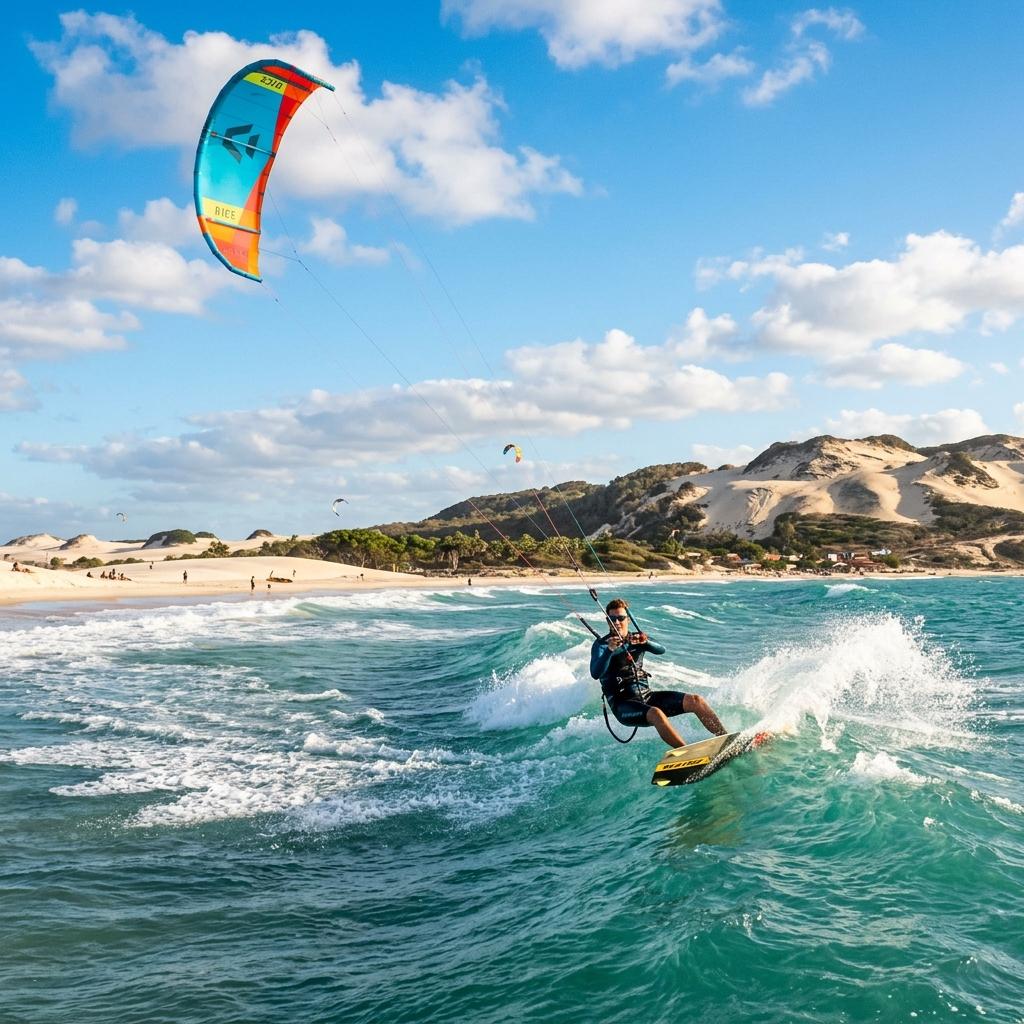
Brazil's northeast coast is not just one of the world's great kitesurf regions. It is genuinely in the argument for the greatest. The combination of south-easterly trade winds that blow with remarkable consistency from July through January, warm crystal water at 28 degrees, enormous flat-water lagoon systems, and world-class freestyle and wave conditions across hundreds of kilometres of coastline makes the Ceara and Piaui states a dedicated kiter's dream. Jericoacoara alone carries a mythological status among the global kitesurf community that very few spots on Earth have matched.
Why Brazil is World-Class
The SE trade wind system that drives Brazil's northeast coast is powered by the South Atlantic High, one of the most stable atmospheric systems on Earth. From approximately July through January, this system delivers a remarkably steady easterly to south-easterly wind directly onto the coastline, running at 20 to 30 knots the vast majority of days. Water temperatures hover between 26 and 30 degrees year-round. The combination is almost unreasonably generous.
Add to this the unique geography of the region: a coastline studded with freshwater lagoons fed by seasonal rains, which fill up between February and June and then sit calm and glassy behind natural dune barriers during the dry, windy season. These lagoons are among the finest flat-water kitesurf environments anywhere in the world.
Best Spots in Brazil
| Spot | Region | Wind | Level | Crowds | Best For |
|---|---|---|---|---|---|
| Jericoacoara | Ceara | E / SE Trades | All Levels | Medium | The benchmark: reliable wind, vibrant scene, flat lagoon nearby. |
| Prea | Ceara | E / SE Trades | Intermediate to Adv | Low | The insider's alternative to Jeri. Powerful, great wave potential. |
| Cumbuco | Ceara | SE Trades | Beginner to Int | Medium | Flat water close to Fortaleza airport. Popular intro spot. |
| Barra Grande | Piaui | SE Trades | All Levels | Low | Part of the Ilha do Caju lagoon system, extraordinary flat water. |
When to Go
July to January is peak season for the northeast coast. The trades are fully active, the lagoons from the previous wet season are still filled, and conditions align perfectly. August and September are statistically the windiest months, with 25 to 30 knot days common. December through January remain strong but begin transitioning toward the wet season.
February to June is the wet season in the northeast. The trades weaken significantly, rainfall increases, and kite conditions deteriorate. This fills the lagoons that make the July to January season so spectacular, so this downtime is a necessary part of the cycle.
Travel Logistics
Flying: Fortaleza International Airport (Pinto Martins, FOR) is the primary gateway for most northeast spots. Direct flights from Lisbon and various European hubs via Sao Paulo (GRU) or connecting in Fortaleza. Journey time from Europe is typically 11 to 14 hours with one connection.
Getting around: A 4WD vehicle is recommended for the best spots, as roads to Jericoacoara and Prea involve sand tracks through dunes. Many kite camps offer transfers. Budget approximately 1,000 to 1,500 euros per week all-in for a comprehensive kite camp experience.